01
Teaching Methods
A focused group of public-domain works connected by subject, literary setting and recurring questions.

Independent digital catalogue
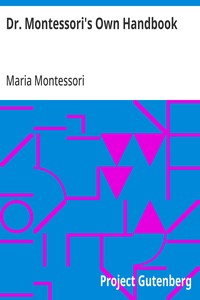
This catalogue indexes 96 public-domain texts on education, teaching, and childhood learning, drawn from Project Gutenberg and organized into four overlapping categories. Rather than a random assortment, the collection traces a practical arc: Teaching Methods offers classroom manuals by figures such as Maria Montessori and John Dewey, while Historical Textbooks provides early language primers like A First Spanish Reader. Schools Learning covers institutional and extracurricular materials, from Sunday schools to biographies, and Educational Theory situates schooling within broader social and philosophical debates—Rousseau, Spencer, and Nietzsche appear here. To enter the collection, try the suggested reading paths: start with Dewey's The School and Society for progressive education, compare historical language texts, or trace pedagogical history through Compayré and Woody. Each record includes catalogue notes and target reader guidance.
Subject gateways
Navigate the catalogue by subject area, historical period, and source type.
A focused group of public-domain works connected by subject, literary setting and recurring questions.
A focused group of public-domain works connected by subject, literary setting and recurring questions.
A focused group of public-domain works connected by subject, literary setting and recurring questions.
A focused group of public-domain works connected by subject, literary setting and recurring questions.
A closer look
One work and three nearby readings from the current catalogue.
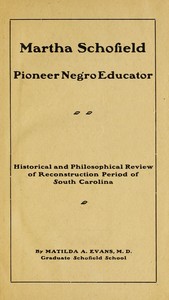
Authored by Authors: Evans, Matilda A., 'Martha Schofield, pioneer Negro ...' stands as a notable and significant work within the Educational Theory category. Matilda A. Evans, M.D., a graduate of Schofield School, writes a biography of Martha Schofield that blends historical review with dramatic, novelistic scenes. The text uses vernacular dialogue and vivid mob episodes to depict Reconstruction-era South Carolina, while the author's foreword frames Schofield's work as a moral crusade against ignorance and superstition. It serves as a vital entry point into the broader subjects represented in our archive.
View catalogue record
Routes through the collection
Four routes into the collection for readers approaching the catalogue with different questions.
Record framework
Explain the presentation and linking of records without altering the source texts they represent.
Connect catalogue pages to the currently listed files and references.
Display title, author, and edition details prominently to aid discovery.
Group works by recurring themes, historical contexts, and educational topics.
Show how records relate while keeping the original wording of the sources intact.
About these records
How the collection is organized, presented and corrected.
It generally means that the represented source text is no longer protected by copyright in the applicable jurisdiction or has been released for public use. Status may vary by country and edition.
A record may include the title, author, category, cover, description, edition information, source references and available reading or download options.
A category reflects a work’s principal subjects, literary setting, source type and relationship to nearby records in the collection.
The catalogue adds navigation, metadata and editorial context. The represented source text retains its wording, edition information and rights status.
Use the contact page and include the work title, page address and the exact attribution, category, metadata or source detail requiring attention.
Catalogue stewardship
Catalogue information
JIMHA Catalogue manages the overall structure of the digital library, which includes 96 books and 115 authors across 4 categories. The collection's completeness is maintained.